New mobility trends force finance firms to shift focus to drivers
The rise of MaaS is forcing financial services firms to focus on the needs and expectations of drivers. Companies that can win driver loyalty by demonstrating their support, especially at critical moments such as breakdowns and accidents, will increase client retention and push up revenue.
The rise of mobility as a service (MaaS) is forcing financial services firms to shift their focus from vehicles to the people who drive them. They’re using increasingly abundant vehicle data to embed their services in the digital ecosystems drivers rely on while traveling. By improving the customer experience, they aim to strengthen client loyalty and grow revenue.
But it’s a move financial service providers can’t make on their own. To embed their offerings across MaaS ecosystems, they need to collaborate with vehicle manufacturers, dealers, rental companies, and other financial services firms. Alliances with vehicle manufacturers are especially important. Those companies control much of the data generated by their vehicles.
“Customers are moving more and more to MaaS platforms. They want embedded journeys and require services that are more intuitive, flexible, and digital,” says Anna Rycombel, Head of Global Sales Automotive at Allianz Partners. [8:47]
Cooperation across MaaS ecosystems will likely involve partners working together on a range of products and approaches, in parallel, to meet different customer needs, adds Rycombel.
She was speaking at an online event hosted by the Qorus Insurance Community and Allianz Partners. Also at the event were Sébastien Patard, GM and CFO at Hyundai Capital France and Lucia Čišková, MD at Business Lease Slovakia. They highlighted the opportunities and challenges service providers are facing with the rise of MaaS.
Key takeaways
Drivers come first: MaaS is pushing financial services firms to design products around the needs and expectations of drivers rather than vehicles.
Data opens opportunities: Increasingly abundant data allows service providers to embed products inside the apps and platforms drivers use.
Partnerships must align: Getting in sync with MaaS partners is one of the biggest challenges facing service providers.
Personalization requires big investment: Highly personalized offerings require major investment in data infrastructure.
Incidents build loyalty: Breakdowns and accidents are the customer experience moments that most shape client loyalty and retention.
Alignment with MaaS partners vital
Nearly 70% of the insurance executives polled at the event said aligning vehicle manufacturers, insurers, leasing companies, and mobility providers was their biggest challenge. A further 15% pointed to difficulties integrating insurance seamlessly into digital mobility journeys. Pricing and monetization of embedded insurance services was the main challenge encountered by 8% of the executives. Another 8% cited regulatory and compliance complexity.
Patard at Hyundai Capital France says embedded MaaS offerings will need to be “ultra personalized” to satisfy customer expectations. This will require service providers to invest heavily in the data infrastructure. They will also need to find ways to monetize data without disrupting the value chain for other companies in the MaaS ecosystem.
Service providers will also have to adapt their distribution to accommodate the introduction of MaaS offerings, says Patard.
Financial services firms quick to adopt MaaS
Despite such challenges, financial services firms are moving quickly to embed their offerings in MaaS ecosystems. Close to 60% of the insurance executives polled at the online event confirmed that their organizations are already using MaaS ecosystems directly or through partners. A further 18% reported that ecosystems are a strategic priority, in development, or in pilot testing. A similar proportion confirmed their firms are exploring MaaS ecosystems but don’t yet have any concrete initiatives.
The rise of MaaS is prompting service providers to redesign their offerings, says Rycombel at Allianz Partners. Insurers, for example, are changing how they assess risk and price cover. They are developing dynamic on-demand products that use telematics and behavioral data to price cover according to vehicle usage.
Allianz Partners provides insurance and assistance services in more than 75 countries and works with partners in the travel, health, and automotive industries. Its MaaS ecosystem partnerships have enabled the company to extend and refine its assistance services. By using connected vehicle and location data, the company can diagnose issues faster, resolve problems remotely or at the roadside, and if necessary, trigger support services. If an on-the-spot fix is not possible, Allianz Partners uses its MaaS ecosystem to quickly provide a stranded driver with alternative transport. Options include courtesy cars, ride hailing services, train connections, or even micro-mobility solutions.
Allianz Partners consolidates mobility options on a single MaaS platform
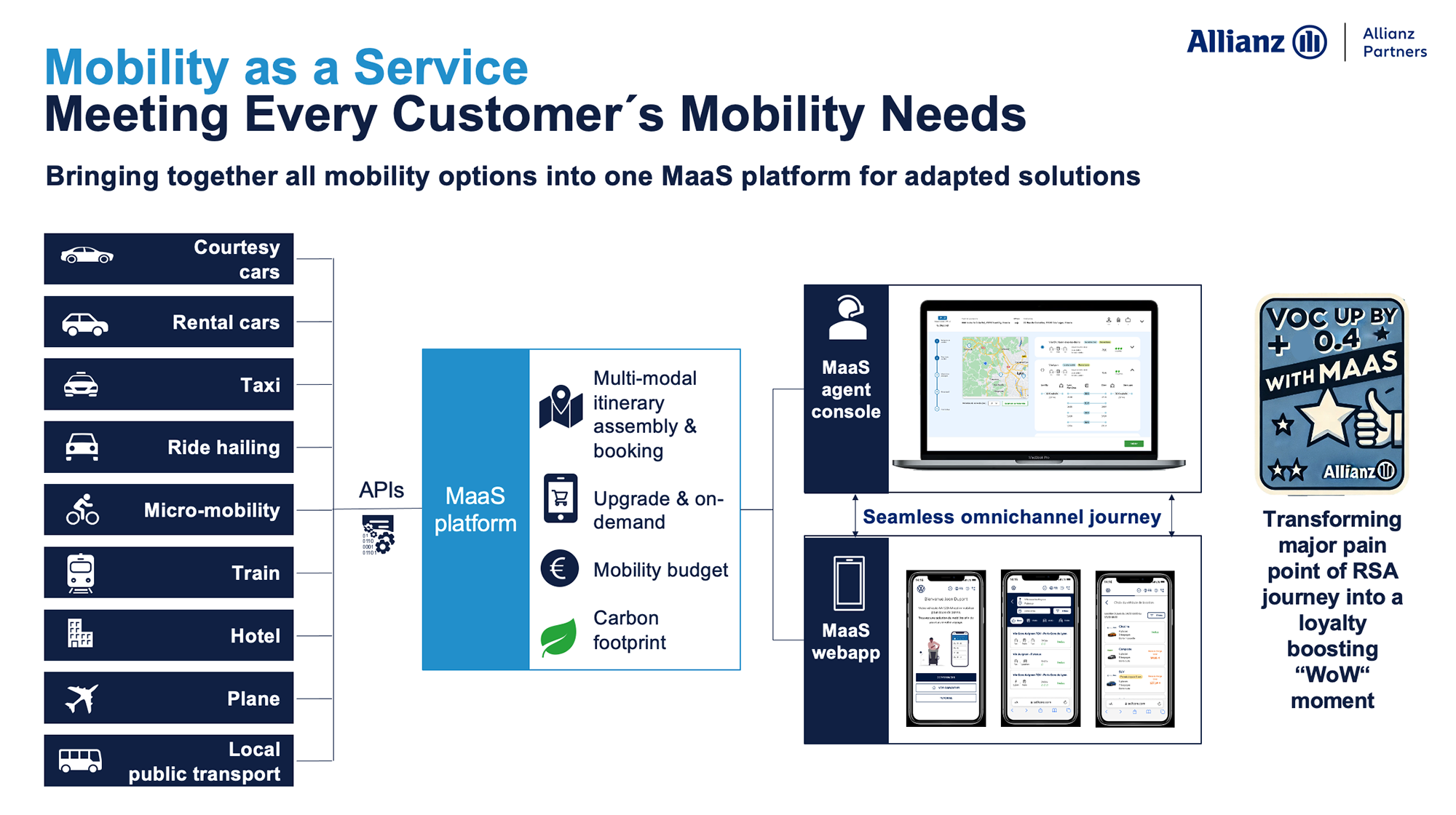
“Human care is most important for us. We want to make sure the client’s journey is interrupted for the shortest time possible and a convenient solution is found as quickly as possible,” says Rycombel. [18:25]
Vehicle breakdowns or accidents are the moments the customer experience is put to the test. If the experience impresses the client, it typically boosts their loyalty to the service provider. But if it’s bad, the relationship will sour and likely be curtailed.
Incident support top touchpoint for drivers
Research by vehicle leasing firm Business Lease Slovakia found that the most important moment in the customer experience of its clients was not when they received a new car but during an unexpected incident.
Guided by the research findings, the leasing company focused on improving its response to incidents as the most effective way to enhance the customer experience. It directed its attention not just on the companies that are its clients but particularly on the drivers who are employed by those firms.
The traditional approach in the leasing business is to serve company customers. Direct interaction with vehicle drivers is often overlooked, says Čišková.
“We have 600 companies in our portfolio who together have 6,000 drivers. We realized that if we focus on those 6,000 people it will lead to higher company satisfaction. Those drivers will say to their fleet managers or purchasing managers, ‘wow the service is really great, they’re taking care of us’. That will lead to greater loyalty from our B2B clients and more repeatable business.” [29:10]
That shift in focus led Business Lease Slovakia to launch its Personal Assistant service. The service draws on resources across a MaaS ecosystem to help drivers after an incident and to keep in touch with them until their case has been resolved. At the heart of the service is a team of assistants who call drivers the day after an incident to check they’re safe and see what support they need.
“The most powerful moment for every driver is receiving service directly from us. They don't expect it. We check on how the assistance was provided, send the driver a small gift with a personalized note from the assistant, and provide updates via SMS or WhatsApp until the car is repaired,”says Čišková [39:15]
Čišková says the Personal Assistant service is already boosting customer satisfaction with the company recently achieving a Net Promoter Score (NPS) score of 92. Furthermore, the service has reduced customer complaints by 20%, curbed client churn by 5%, and is forecast to add around €3 million a year in revenue.
The rise of MaaS is forcing financial services firms to focus on the needs and expectations of drivers. Companies that can win driver loyalty by demonstrating their support, especially at critical moments such as breakdowns and accidents, will increase client retention and push up revenue. Delivering such support requires strong partnerships, robust data infrastructure, and highly personalized embedded products.
Don’t miss the next online event hosted by the Qorus Insurance and Embedded Insurance Community
Insurance & Embedded Insurance community
With Qorus memberships, you gain access to exclusive innovation best practices and tailored matchmaking opportunities with executives who share your challenges.