Europe’s three strongest mobility models leave others trailing
Europe has attracted scores of innovative mobility services. But few have scaled into viable businesses. Demanding regulations, high costs, unstable revenues, and customer price resistance have derailed many promising initiatives. Some never got beyond pilot testing
Europe has attracted scores of innovative mobility services. But few have scaled into viable businesses. Demanding regulations, high costs, unstable revenues, and customer price resistance have derailed many promising initiatives. Some never got beyond pilot testing.
“Pilots are very nice to see whether things work or not. But the problem is that pilots cannot measure what the result is at scale,” says Markus Collet, partner and head of the Automobility Platform at Corporate Value Associates (CVA). [1:00:49]
Success now depends on more than innovation. “The investor mindset has changed compared to some years ago because of higher interest rates. There’s more focus on profitability and on recurring revenues,” says Collet. [8:13]
Full-service leasing, short-term rental, and ride-hailing have emerged as Europe’s strongest mobility models. Many others remain commercially unproven.
Collet was speaking at an online event hosted by Qorus and CVA that discussed new mobility models in Europe. He was joined by Rui da Silva Duarte, head of mobility solutions at Arval Spain, and Nimeshh Patel, chief executive officer of UK insurtech Wrisk.
Key takeaways
- Europe has produced many innovative mobility services, but few have scaled into viable businesses.
- Regulation, high costs, unstable revenues, and customer price resistance remain major barriers to scaling mobility models in Europe.
- Full-service leasing, short-term rental, and ride-hailing have emerged as Europe’s most mature mobility services.
- A second group of mobility models, including shared micromobility, used-car leasing, and robotaxis, is showing signs of profitability but has not yet scaled fully.
- Scaling mobility services depends not just on innovation, but also on strong partnerships, financial discipline, and business models that can generate predictable revenues.
How Arval and Wrisk are building for growth
A subsidiary of financial services group BNP Paribas, Arval is a leading global provider of fleet management services. Wrisk’s digital platform and data technology help insurers embed their products in the digital ecosystems of automotive original equipment manufacturers (OEMs). Both Arval and Wrisk have spent the past decade building mobility models that can scale.
He adds that Arval is no longer just a fleet management provider but a mobility operator built around mobility, technology, and sustainability.
“We are able to address flexible, short-term needs and multi-modal requirements.” [43:50]
Arval announced last December that it is negotiating with Mercedes-Benz Group to acquire lease management firm Athlon. The acquisition, which is subject to regulatory approval, would significantly strengthen the company’s presence in Europe.
Wrisk is using the platform and partnerships it built in its home market to expand in Europe.
In January, Wrisk closed a Series B round of funding which included an investment from Allianz, one of the firm’s early insurance partners. The following month, the insurtech acquired UK firm Atto, a realtime platform that uses Open Banking data to provide credit scoring and income verification insights. The acquisition brings financial intelligence into Wrisk’s insurance platform.
Patel describes Wrisk as the “jam in the sandwich” that connects insurers’ products to the digital customer experiences provided by automotive OEMs.
“Our end game is to be the super orchestrator, the business that builds an intelligence moat around the distribution of insurance and multiple products.” [37:09]
He adds that Wrisk is looking to expand its platform to help OEMs sell finance products and after-sales services across the same digital ecosystems.
Both Duarte and Patel highlighted challenges that make scaling mobility models difficult. Unstable revenues and partnership complexities are especially demanding, notes Duarte.
Duarte says partnerships work best when both sides share a clear view of the business model and bring proven strengths to the table. Patel adds that regulatory complexity and Europe’s conservative approach to capital allocation can prevent promising mobility models from surviving long enough to reach scale and profitability.
Executives polled at the event identified regulation as the biggest cause of failure among mobility providers in Europe. Other factors included high costs, inappropriate business models, high interest rates, and competition from incumbents. Full-service leasing is the sector with the strongest relative growth prospects over the next four years, say the executives. They ranked it ahead of shared micromobility, car subscription, and B2C car sharing.
The mobility models pulling ahead in Europe
To see which mobility services are gaining traction, CVA’s Collet reviewed the market and business maturity of 10 models. He then scored them out of 10 and identified the high-performing “full steamers”, the up-and-coming “scalers”, and the uncertain “question marks”.
How 10 mobility models rank on maturity and profits
1. Ride-hailing (Score = 8)
Led by platforms such as Uber, Grab, and Didi, ride-hailing has become a large-scale, profitable mobility category, although some regional operators still lag market leaders.
2. Robotaxi (Score = 6)
Despite major shutdowns, robotaxis are moving beyond hype as operators such as Waymo show promising traction.
3. Shared micromobility (Score = 7)
Early hype has faded, but shared micromobility platforms are regaining credibility as usage grows and companies such as Lime show that profitability is possible at scale.
4. Fleet-based B2C car sharing (Score = 4)
Fleet-based B2C car sharing has yet to prove durable at scale or demonstrate profitability after many of its early leaders failed.
5. Peer-to-peer car sharing (Score = 4)
Peer-to-peer car sharing continues to struggle as trust remains a structural obstacle, with many drivers reluctant to hand over their cars to others, and several providers retreating or closing.
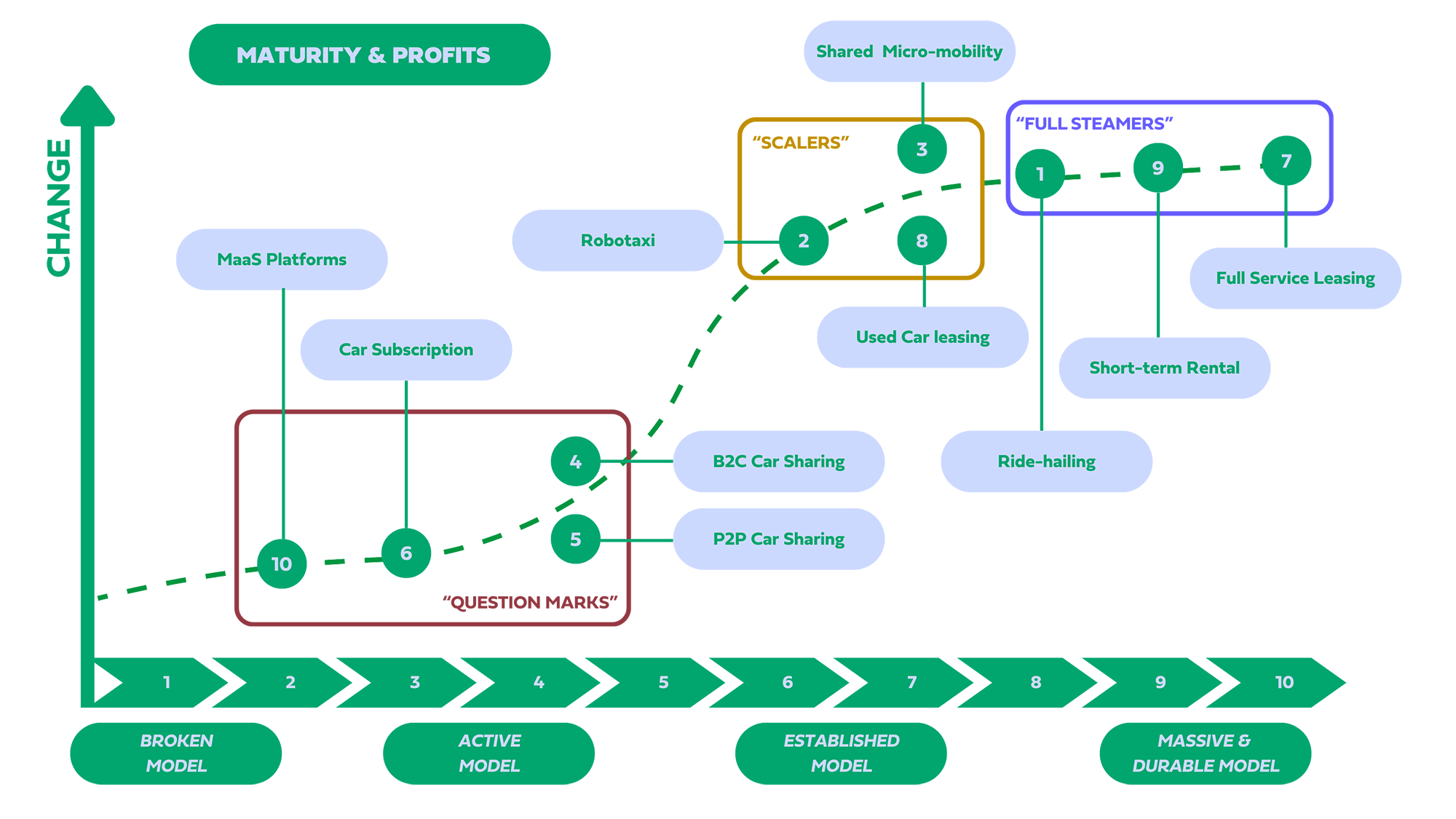
6. Car subscription (Score = 3)
The car subscription market has failed to live up to its early hype and its flexible business model has proved difficult to scale.
7. Full-service leasing and fleet management (Score = 10)
Europe’s most mature mobility model, full-service leasing has established itself as mainstream and highly profitable with growth opportunities among SMEs and consumers.
8. Used-car leasing (Score = 7)
Used-car leasing is gaining momentum with firms such as Lizy showing it can be profitable, but the model still faces challenges around residual values, pricing, and broadening its customer base.
9. Short-term rental (Score = 9)
Short-term rental remains a highly mature category despite recent volatility, with firms such as Sixt showing that strong profits are still possible through digitisation and tight operational control.
10. MaaS platforms (Score = 2)
Mobility-as-a-service platforms have attracted plenty of interest but still show little evidence of an ability to scale or become durable businesses.
Europe will likely attract many more innovative mobility services. But only those that can turn smart ideas into durable businesses will succeed. The past decade has shown that success in Europe’s mobility market requires scale, sustainable revenue, strong partnerships, and financial discipline.
The Qorus Mobility Community provides executives at banks, insurers, fintechs, leasing companies, captives, and rental car companies an environment where they can work together to meet challenges facing the mobility sector. The community explores key trends, showcases best practices, and facilitates knowledge-sharing through online events, conferences, research, and digital resources.
Mobility community
With Qorus memberships, you gain access to exclusive innovation best practices and tailored matchmaking opportunities with executives who share your challenges.