Challenging yourself: How traditional banks are forging their own challenger banks
Starting a bank-within-a-bank is no small feat. In this edition of Voice of the members, we look at what led certain financial institutions to launch their own neobank. How do you position the neobank in the market? Do you target a new segment or cannibalize current customers? Are the neobanks granted complete independence from their parent institution? We asked all these questions and more to understand this phenomenon from those who know it best.

Starting a bank-within-a-bank is no small feat. In this edition of Voice of the members, we look at what led certain financial institutions to launch their own neobank. How do you position the neobank in the market? Do you target a new segment or cannibalize current customers? Are the neobanks granted complete independence from their parent institution? We asked all these questions and more to understand this phenomenon from those who know it best.
This report gathers exclusive interviews from top executives at: ActivoBank (Millennium bcp), buddybank (UniCredit), Discovery Bank (Discovery), EON (Union Bank of the Philippines), Hello Bank! (BNP Paribas), imagin (CaixaBank), au Jibun Bank (MUFG), Liv. (Emirates NBD), Mox (Standard Chartered Bank), Next (Banco Bradesco), Space (TBC Bank), Woop (Sicredi).
We want to thank all contributing members of Qorus for providing their expertise and insight for this newest edition of Voice of the members.
The challenge of incumbent-owned challenger banks
Only a few months ago — it seems ages ago — legacy retail banks were carrying out their digital transformation at their own pace, i.e. slowly but surely for most. The Covid-19 pandemic and the resulting lockdown forced them to drastically accelerate the pace of change. Within weeks and even days, traditional banks found ways to remotely handle processes they had, for a long time, been reluctant to move online, away from the branches.
Digital is the new normal
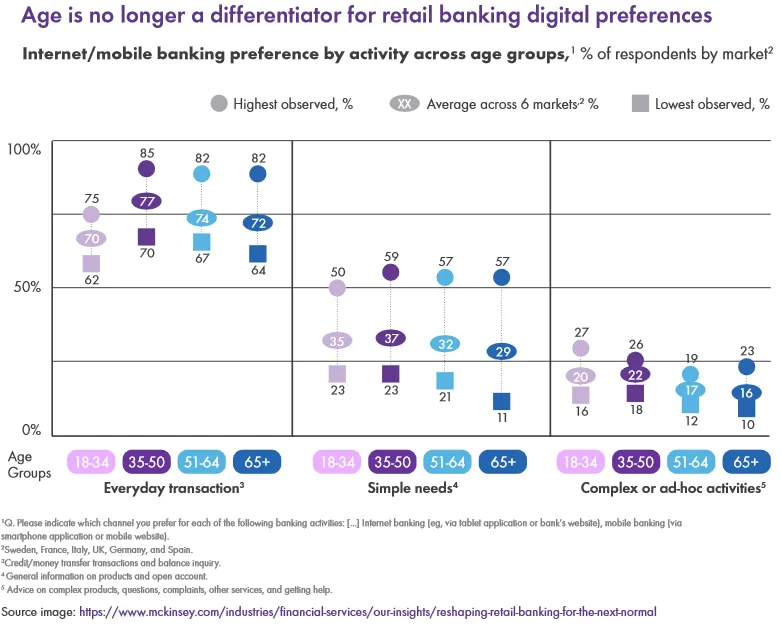
Digital suddenly became the ‘new normal.’ As the lockdown was extended, new consumer behaviors have taken root and new expectations emerged. Research by McKinsey1 on Covid-19’s impact on banking shows, for example, that across Western European markets, 60 to 85 percent of customers now express a preference for handling everyday transactions digitally. That figure would have taken two to three years to reach at the pre-crisis pace of change.
As digital-only or digital-first banks, the challenger banks owned by traditional banks were launched to counter the offensive of startup neobanks and challenger banks. They now seem well positioned to benefit from the digital acceleration wrought by the Covid-19 crisis.
For this issue of the Voice of the members, we asked twelve incumbent-led challenger banks from eleven countries and four continents to share their plans for competing in the new landscape: ActivoBank (Millennium bcp, Portugal), buddybank (UniCredit, Italy), Discovery Bank (Discovery, South Africa), EON (Union Bank of the Philippines), Hello Bank! (BNP Paribas, France), imagin (CaixaBank, Spain), au Jibun Bank (KDDI, MUFG, Japan), Liv. (Emirates NBD), Mox (Standard Chartered Bank, HK), Next (Banco Bradesco, Brazil), Space (TBC Bank, Georgia), Woop (Sicredi, Brazil). Their contributions reveal the challenge they are facing as separate ventures, as well as the innovation labs of their parent company.
Mobile challenger banks for the millennials
Across the world, incumbent banks have launched challenger banks with strongly similar core goals.
• Firstly, they want them to develop a separately branded offering suited to the needs of the new generation of banking customers, the digitally savvy and the digitally native millennials and generation Z. The goal is to stop these customers from flocking in millions to fintech banks such as Revolut, N26, or Nubank.
• Secondly, the challenger bank must function as an innovation lab, a testing ground for new products, new business models, and advanced digital technologies.
Concretely, to attract millennials challenger banks must be simple, fast, and accessible mobile-only or at least mobile-first offerings. They are often marketed in distinctively soft or bright colors, with short, cool names such as Max, Marcus, MOX, Finn, Next or Woop, and with loss-leading offers such as free payment cards or no-fee checking accounts.
However, beyond these similarities, the higher ambitions of legacy bank-owned challenger banks vary.
Many aim to reinvent the banking experience by centering it on the life goals and the lifestyles of digitally savvy users. With the help of multidisciplinary teams, including non-bankers, and management consultancies, they design new approaches such as lifestyle banking (Liv. Bank, imagin), behavioral banking based on financial health goals (Discovery Bank), or conversational banking based on AI customization (buddybank, Mox).
Others such as BNP Paribas in France and TBC Bank in Georgia more pragmatically want to use their mobile banking apps, Hello Bank! and Space, to expand internationally. Others again, such as investment bank Goldman Sachs or insurance company Discovery use their challenger banks, Marcus and Discovery Bank, simply to enter retail banking.
Varying degrees of independence
As incumbent bank-owned ventures, most challenger banks must arbitrate between maximizing the synergies with their parent company or exploring true, i.e. independent alternatives. At their current level of maturity and size—with a median age of 3 years and median size of 435,000 customers—most challenger banks in our sample favor synergies over independence. It helps them keep investments and operating costs down.
Making use of the infrastructure of the parent company, for example its ATM network and its compliance resources, also enables them to offer better quality services. Commercially, most of these challenger banks sell products from their parent company. Some, such as EON in the Philippines and Hello Bank! in Belgium are able to switch high-end or older customers from the challenger bank to the parent bank, the Union Bank of Philippines and Fortis Bank, respectively.
Only three of the twelve challenger banks surveyed (Discovery Bank, au Jibun Bank, and Mox) operate under their own banking license. Only five (Discovery Bank, au Jibun Bank, Mox, Next, and Space) run their own technology stack with its own architecture. au Jibun Bank of Japan, a pioneering joint venture between telecom operator KDDI and Mitsubishi bank with 12 years of experience in mobile banking and 4 million customers, and Discovery Bank owned by South African insurance company Discovery are cases in point. Both are not strictly speaking legacy-bank led. They do not operate directly under a legacy bank.
The challenge of self-disruption
Observers have often noted that the notion of an incumbent bank-led challenger bank is an oxymoron. It is indeed a form of controlled self-disruption. Legacy banks adopt this strategy in the hope that their challenger banks can stick to the delimited customer target of digital natives and digitally savvy customers, and thereby counter fintechs without cannibalizing their parent bank’s customer portfolio.
Liv. Bank, for example, prides itself on bringing in customers, 95% of whom are new to its parent bank, Emirates NBD, causing only 5% cannibalization. The Brazilian challenger bank called Next claims that 78% of its customers are new to its parent company Bradesco Bank, a much higher 22% cannibalization rate.
Is this strategy sustainable in the long-term? Can legacy banks create challenger banks that reach a viable critical mass without cannibalizing their owner’s business model?
It seems unlikely. It seems that legacy banks will not be able to avoid the impact of the tight economics of the low- cost challenger bank model. The risk is that profitable customers of the legacy bank such as the older consumer segments become self-service digital customers who pay close to no commissions and fees and buy fewer products. As noted by McKinsey in the above-mentioned study, generation X and baby boomers are already following millennials in their preference for digital banking channels.
For these reasons, several large legacy banks, including J.P. Morgan Chase in the US, NatWest in the UK, and BPCE in France have ditched their challenger bank strategy. They folded their initiatives after a short experimentation phase to refocus their developments on improving their existing offerings.
Optimistic for their full-service offerings
The incumbent-owned challenger bank strategy is a challenging game to play when it encroaches on this incumbent bank’s existing territory. Yet, the executives we surveyed for this Voice of the members report are optimistic. They are fully aware of the intense competition their challenger bank is facing. However, they are confident in their proposition. They believe that the link to the legacy bank uniquely positions their mobile bank to propose the full-service financial and lifestyle offerings modern customers need.
Although they acknowledge the contribution of neobank startups, they do not believe that these will be able to expand their product and service offerings quickly enough and with enough quality, even with open banking. They also believe that big tech companies will prefer to partner with banks rather than submit to financial regulation.
A bank for the next generation of customer
When it comes to financial services, banks are beholden to rapidly changing customer preferences. Older customers may still prove to be a reliable source of revenue, but all bankers realize the impetus to adapt to changing preferences in order to remain viable long into the future. The next generation of customer has a smartphone, rarely visits a bank branch, and expects immediate access to their finances at all hours of the day.
Everyone knows that changing banks can be a difficult and painful process. The key for these challenger banks will be to acquire customers when they are young so they become the institutions and banks that people are reluctant to leave when they are older. This is why you see financial institutions pour vast resources into customer acquisition. If a bank is able to acquire customers before they turn 25, they can cultivate customer loyalty and the lifelong relationships that are so valuable to any institution.
With the explosion of banking options in recent years all around the globe, traditional banks have seen digital and challenger banks enter the market, competing for a slice of the financial services pie. There is no question the market has been transformed by mobile-based banks catering to changed customer habits. Traditional players have examined the changed landscape and searched for the appropriate response to new competition.
For many traditional financial institutions, their answer to new competition has been to develop their very own challenger bank. These new banks are intended for a different demographic – with new names, branding, and offerings. With their slate of digitally-focused features, these new challenger banks are free of the buttoned-up image that might accompany their parent institutions. As you’ll see in the following interviews, these executives understand the way the market has shifted, and the importance in adapting to a new type of customer.
Read on to find out how executives from top banks all over the world are constructing digital banks to meet the needs of the modern-day customer
Interviews
Leverage community expertise to redefine finance
Our communities cover diverse topics such as digital transformation, SME finance, or Embedded insurance, providing a platform to learn from industry experts and peers.